
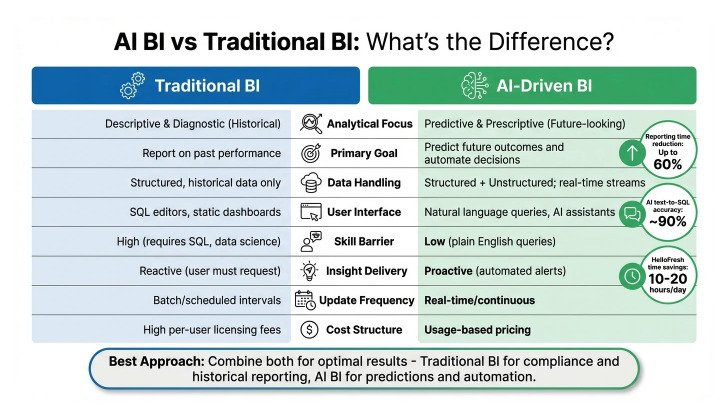
As organizations increasingly depend on data to inform decision-making, business intelligence (BI) has become an essential capability. However, traditional BI systems largely adhere to conventional paradigms and struggle to process, analyze, and extract value from the massive volumes of data generated on a daily basis. In response to these limitations, AI-driven analytics has emerged as a transformative approach, leveraging artificial intelligence techniques such as machine learning (ML) and natural language processing (NLP) to deliver real-time insights, predictive forecasts, and actionable recommendations.
This study examines the evolving landscape of BI in the era of AI-driven analytics, highlighting the key differences between traditional BI and modern intelligent analytics systems, as well as their applications across multiple industries. It also addresses the challenges associated with implementing AI-enabled BI solutions and proposes strategies to mitigate these issues. By adopting AI-driven analytics, organizations can significantly enhance operational efficiency, improve decision accuracy, and strengthen strategic decision-making in highly competitive environments.
The exponential growth of data in the age of big data has made value extraction a critical challenge for businesses. The ability to analyze large and complex datasets has become a defining factor that distinguishes high-performing organizations. Historically, BI has supported decision-making through descriptive and historical analysis, primarily within operational contexts. While these capabilities remain valuable, they are increasingly insufficient given the scale, speed, and complexity of modern data generation. Traditional BI tools struggle to keep pace with continuously evolving data streams and are limited in their ability to address both anticipated and predictive analytical needs [4].
AI-driven analytics integrates artificial intelligence technologies—including machine learning, natural language processing, automation, and advanced BI workflows—to overcome these limitations. By enabling real-time analysis, pattern recognition, and predictive inference, AI-driven systems allow organizations to draw deeper insights and make more informed decisions. Unlike classical BI systems, which rely heavily on human intervention, AI-driven analytics automates large portions of data processing and interpretation, substantially reducing the time and effort required to derive meaningful insights [5].
The transition from traditional BI to AI-driven analytics represents not merely a technological shift, but a strategic transformation. Organizations across industries are recognizing the competitive advantages offered by AI-supported insights, which enable superior customer experiences, process optimization, and operational resilience. In retail, AI-powered analytics support personalized shopping experiences and optimized inventory management. In healthcare, predictive analytics improve patient outcomes and operational efficiency. Financial institutions leverage AI to detect fraud and enhance compliance monitoring [11].
Despite these benefits, the adoption of AI-driven analytics presents significant challenges. Data-related issues such as privacy concerns, integration with legacy systems, and shortages of skilled AI professionals remain major barriers to widespread implementation [3]. Furthermore, ethical considerations—including algorithmic bias and opaque decision-making—underscore the importance of responsible system design, governance, and continuous monitoring [10]. This study focuses on how AI-driven analytics is reshaping the trajectory of business intelligence, beginning with an examination of the historical evolution and inherent limitations of traditional BI systems.
The Evolution of Business Intelligence
Over the past several decades, business intelligence has evolved substantially. Early BI systems relied heavily on manual data collection and offered limited real-time or predictive capabilities. Initially, BI focused on descriptive analytics—answering the question of “what happened”—to support organizational reporting and performance tracking. However, as data sources grew in volume, variety, and complexity, the shortcomings of traditional BI became increasingly evident [17].
Traditional BI systems primarily generated reports from structured internal data sources, such as sales databases and Enterprise Resource Planning (ERP) systems. While effective for organizations with relatively modest data requirements, these systems became obsolete as big data characteristics pushed them beyond their design limits. Key limitations of traditional BI include:
-
Heavy reliance on manual processes: Significant human effort was required for data extraction and analysis.
-
Historical focus: Insights were largely retrospective, offering little support for forecasting or strategic planning.
-
Scalability constraints: Traditional BI struggled to process unstructured or large-scale datasets.
-
Lack of real-time insights: Reporting was often static and periodic, reducing organizational agility.
The Transformation of BI Through AI-Based Analytics
The emergence of AI-driven analytics marks a pivotal shift in the evolution of BI. Advances in machine learning, natural language processing, and automation have enabled a transition from descriptive analytics toward predictive and prescriptive models [6]. These technologies are designed to process unstructured data, integrate vast data volumes, and generate real-time insights that can be directly operationalized.
AI-driven analytics democratizes BI by making advanced analytical capabilities accessible to non-technical users. Through conversational interfaces and intelligent automation, users can interact with data using natural language, reducing dependence on specialized technical expertise. This decentralization expands BI adoption across organizations. For example, AI-powered tools such as Amazon QuickSight employ neural networks and conversational analytics to enable intuitive data querying and instant visualization [9].
The foundational components of AI-driven BI include:
-
Machine Learning: Enables accurate pattern detection and forecasting of future trends.
-
Natural Language Processing: Allows users to interact with BI systems through natural language queries.
-
Automation: Minimizes human intervention, accelerating data analysis and reporting workflows.
Together, these capabilities transform BI from a reactive tool focused on past performance into a proactive system that supports strategic planning and future-oriented decision-making [14]. This study concludes by reflecting on the future role of AI-driven analytics in shaping the next generation of business intelligence and organizational strategy.
Citation
TY - JOUR
AU - Ehsan, Asif
AU - Hossain, Mohammad
AU - Hassan, Mahafuj
AU - Saliao, Jessica
AU - Scholar Y, Research
PY - 2026/01/13
SP - 1
EP - 14
T1 - FROM TRADITIONAL BI TO INTELLIGENT ANALYTICS: THE RISE OF AI-DRIVEN SOLUTIONS FOR ACCURACY, SPEED, AND STRATEGY
VL - 4
DO - 10.34218/IJAIB_04_01_001
JO - INTERNATIONAL JOURNAL OF ARTIFICIAL INTELLIGENCE IN BUSINESS
ER -