
The development of advanced structural, functional, and quantum materials plays a critical role in addressing global challenges such as energy scarcity and the rapid growth of information technologies. Traditional materials discovery and design have largely relied on trial-and-error experimentation and domain-specific expertise, resulting in high costs, long development cycles, and limited scalability. In recent years, data-driven approaches based on machine learning have emerged as a transformative paradigm in materials science, complementing empirical experimentation, phenomenological theory, and physics-based simulations.
A central challenge in materials science lies in understanding and navigating the composition–processing–(micro-)structure–property (CPSP) relationships that govern material behavior. Machine learning has been increasingly applied to model individual links within this chain, including synthesis pathway identification, microstructure engineering, and property prediction. Despite significant progress, a comprehensive and quantitative understanding of CPSP relationships across the full compositional and functional space remains elusive, primarily due to the high dimensionality and complexity of the design space.
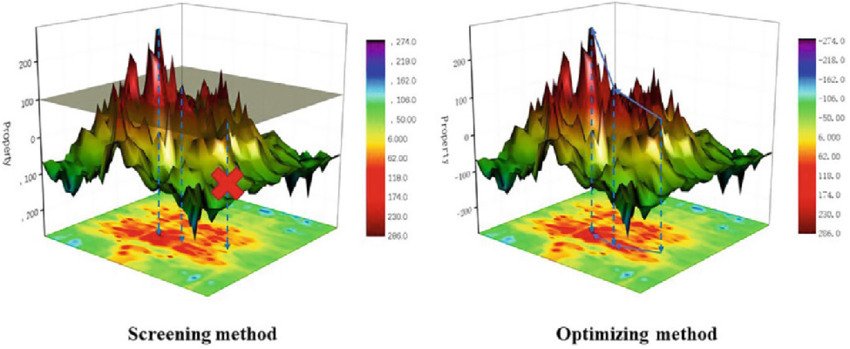
Consequently, most current materials design workflows follow a forward, many-to-one paradigm, in which candidate materials are generated, evaluated, and screened to identify those with optimal properties. To further accelerate materials discovery, inverse design approaches—aimed at directly identifying material compositions and processing conditions that yield targeted properties—have gained increasing attention. Existing inverse design strategies include high-throughput computational screening, global optimization methods, and, more recently, generative machine learning models.
High-throughput workflows, often based on density functional theory and automated simulation platforms, enable systematic exploration of crystal structures and intrinsic properties but remain computationally demanding. Global optimization techniques, such as Bayesian optimization and genetic algorithms, reduce computational costs by constructing surrogate models and iteratively guiding the search process, enabling closed-loop adaptive design integrated with experiments. These approaches have demonstrated success across a range of material systems.
More recently, generative deep learning has emerged as a promising framework for inverse materials design. By learning compact latent representations of high-dimensional material descriptors, generative models enable efficient exploration of design spaces and the generation of novel candidate materials beyond known data distributions. Approaches such as variational autoencoders, generative adversarial networks, and diffusion-based models offer distinct advantages in capturing joint distributions of material structures and properties. However, challenges remain in constructing physically meaningful latent spaces, integrating domain constraints, and performing efficient multi-objective optimization.
In this review, we focus on inverse design strategies for materials based on generative deep learning, with particular emphasis on crystal structure–intrinsic property and microstructure–extrinsic property relationships. We examine key methodological components, including material representations, deep learning architectures, and constraint integration, and summarize recent advances in the field. Finally, we discuss open challenges and provide an outlook on future research directions for generative inverse materials design.
TY - CHAPAU - Zhang, YixuanAU - Long, TengAU - Zhang, HongbinPY - 2026/01/14SP - 127EP - 166SN - 978-3-032-04128-9T1 - Generative Deep Learning for the Inverse Design of MaterialsVL - DO - 10.1007/978-3-032-04129-6_8ER -
For the full paper: https://www.researchgate.net/publication/399697184_Hybrid_AI-Manual_Migration_Framework_Best_Practices_for_Transitioning_from_Angular_to_React